Social Work in England: A Profession Out of Step with the Public It Serves?
How a Critical Profession Became 12 Times More Gender-Diverse Than the Children It Protects.

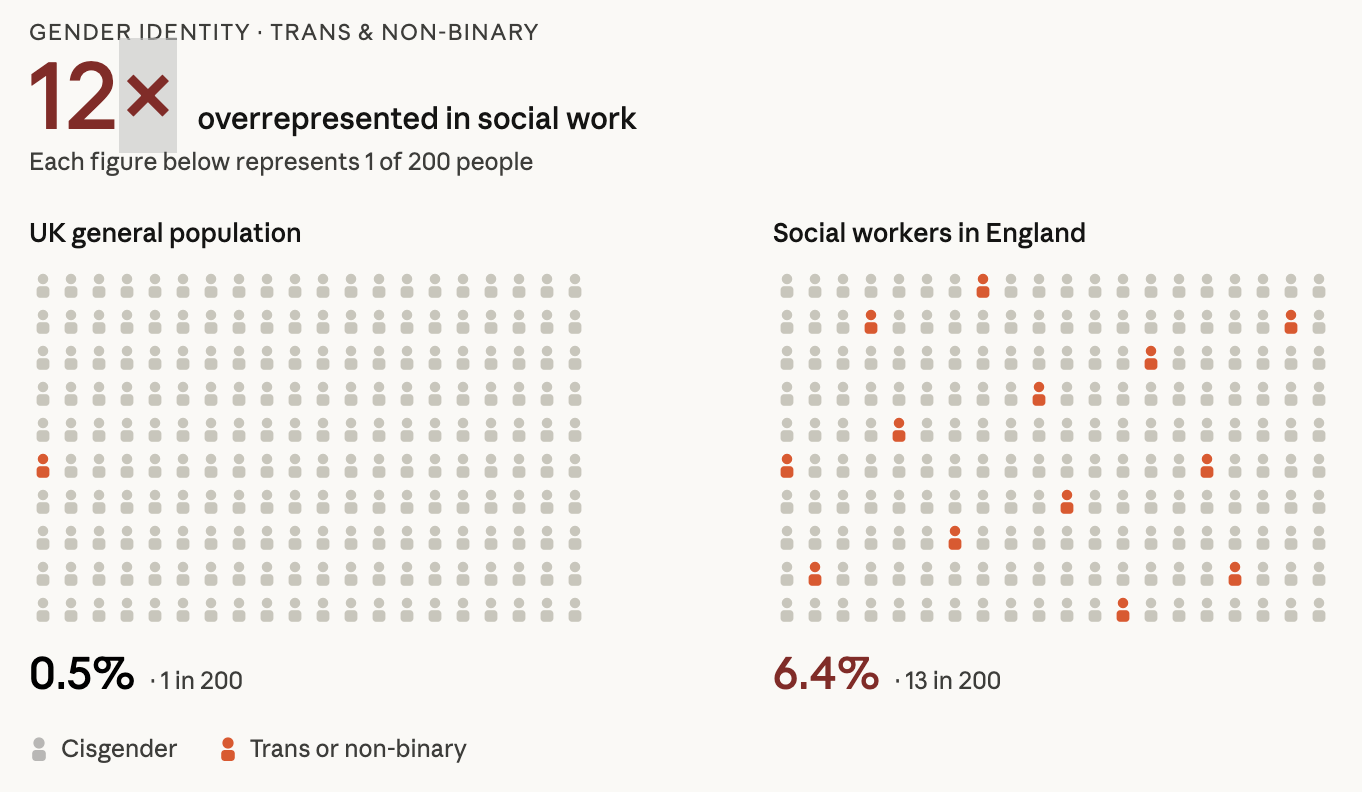
Social workers hold immense power over families in England. From child protection and school safeguarding to foster care and mental health interventions, their judgments can reshape lives. Yet newly released data from Social Work England (SWE) shows that the profession’s demographic makeup diverges sharply from the population it serves, especially on questions of gender identity.
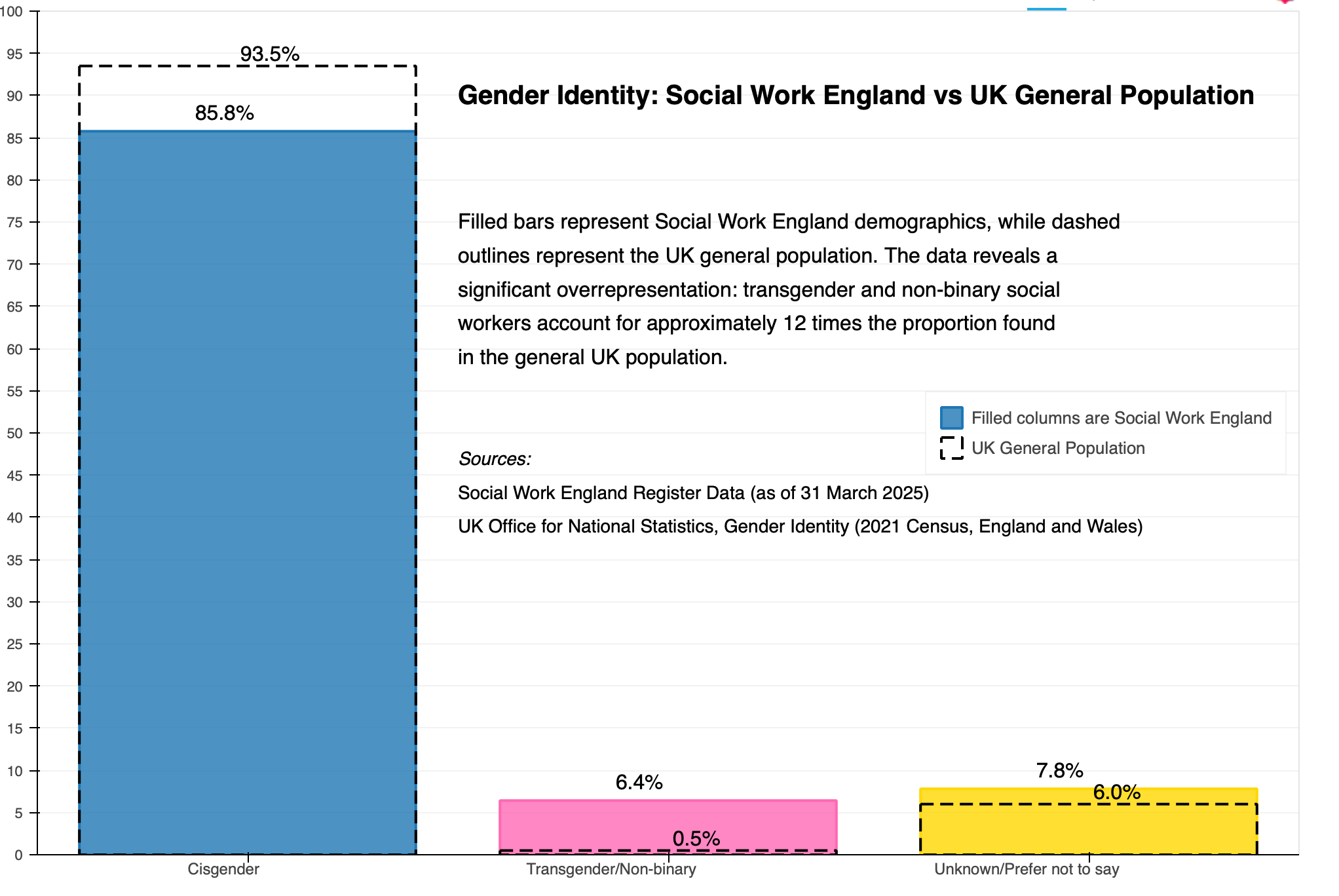
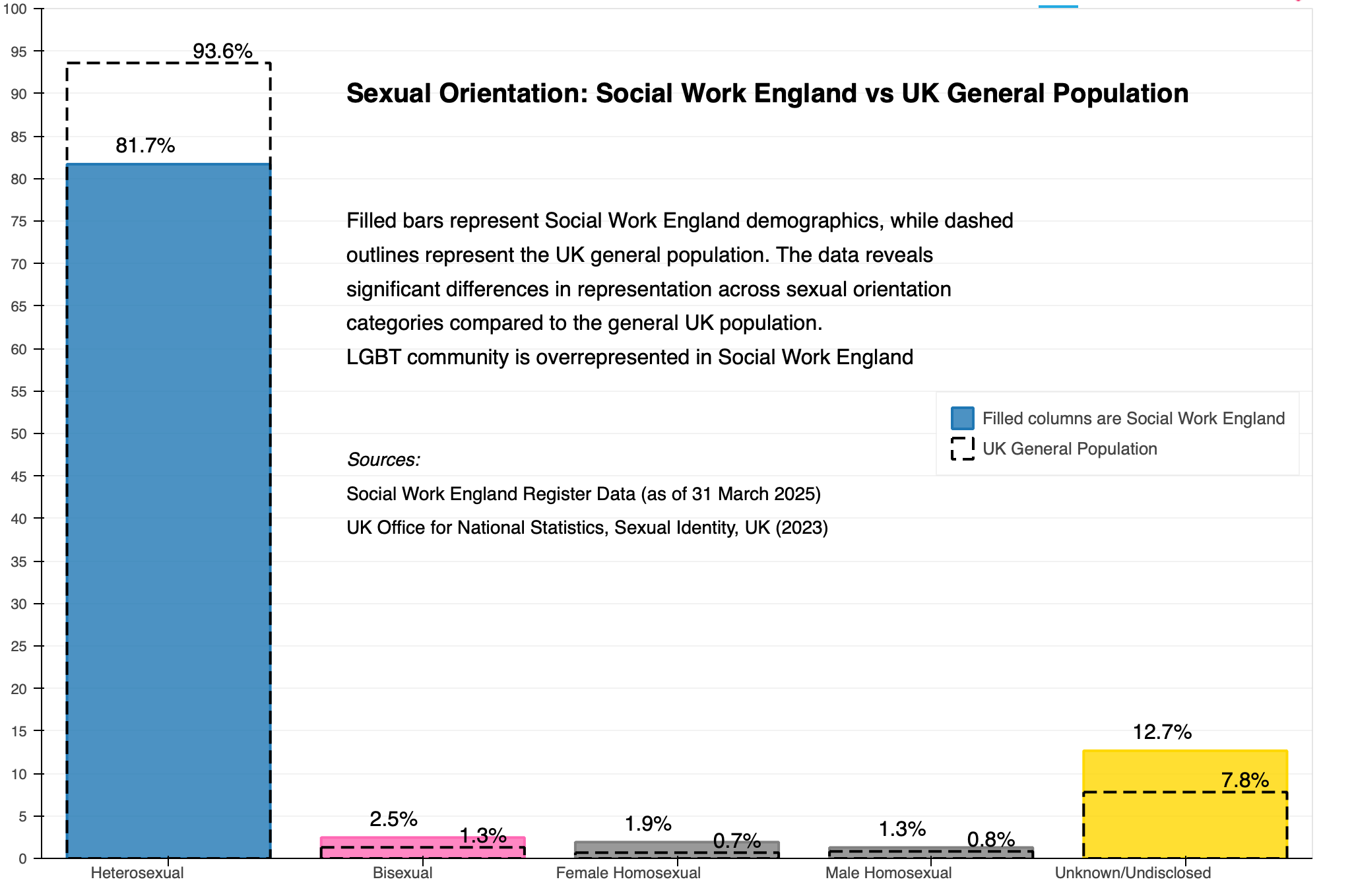
Of the 104,857 registered social workers in England, 6.4% identify as transgender or non-binary, more than 12 times the estimated 0.5% prevalence in the general UK population, according to Office for National Statistics (ONS) figures. Similarly, while 93.6% of the UK identifies as heterosexual, only 81.7% of social workers do—a gap of nearly 12 percentage points.1
These aren’t marginal differences. They suggest a profession that is demographically distinct in ways that could affect public confidence, particularly among families from conservative, religious, or culturally traditional backgrounds.
Why the gap matters
Social work has long prided itself on inclusivity and advocacy for marginalized groups. Many LGBTQ+ individuals are drawn to the field precisely because of their lived experience with discrimination. This may explain the profession’s higher representation of non-heterosexual and gender-diverse practitioners.
But when those tasked with making high-stakes decisions about children’s welfare, such as whether a child should be removed from a home or what support a school should provide, come from a demographic sliver that is vastly overrepresented compared to the national average, concerns about ideological alignment and cultural competence arise.
Transparency and trust
Equally notable is the fact that 12.1% of social workers declined to disclose their sexual orientation, compared to 7.5% in the general population. While this may reflect privacy preferences, it also raises questions about workplace culture and whether professionals feel pressure to conform to certain norms to succeed.2
The data itself is neutral, but its interpretation is not. High representation of any group isn’t inherently problematic. What matters is whether professional judgment remains evidence-based, child-centred, and respectful of diverse family structures and beliefs.
Yet in an era where gender identity debates permeate schools, healthcare, and youth services, the disproportionate presence of gender-diverse practitioners in a field that directly intervenes in family life warrants public scrutiny, not as a critique of identity, but as a safeguard for impartiality.
A call for clarity, not condemnation
No one is suggesting that transgender or LGBTQ+ social workers are unfit for their roles. On the contrary, their perspectives can be invaluable. But the scale of the disparity, particularly on gender identity, deserves serious examination by regulators, policymakers, and the public.
Are recruitment practices unintentionally filtering out candidates from more traditional backgrounds? Are parents from certain communities less likely to trust the system as a result? And crucially: are safeguarding decisions being made through a universally accepted child-welfare lens, or through frameworks influenced by evolving and contested ideological perspectives?
Social Work England should commission independent research into these questions. Families deserve a system that reflects the diversity of British society, not just in protected characteristics, but in worldview, culture, and belief.
Because when the professionals holding authority over our children look nothing like the population they serve, the burden of proving neutrality falls squarely on the profession itself.
Data Sources: - Social Work England Register Data (as of 31 March 2025) - UK Office for National Statistics, Sexual Identity, UK (2023) - UK Office for National Statistics, Gender Identity (2021 Census, England and Wales)
Methodology Notes: - SWE data represents all registered social workers - UK comparison data based on ONS household surveys and Census - Percentages calculated from totals: 104,857 (SWE) and 54,000,000 (UK, age 16+) - “Unknown/Undisclosed” category combines “Prefer not to say,” “Unknown,” and “Prefer not to self-describe” for sexual orientation